When to Hire a Historical Consultant, and What to Expect
Hire a heritage consultant when a project needs historical evidence researched and interpreted to professional standards; here is what to ask first.
Hire a heritage consultant when a project depends on historical evidence that must be found, documented and interpreted to professional standards, and your own team lacks the time, training or independence to do it. Common moments include an anniversary history, an oral history program, an exhibit, a preservation or compliance filing, a curriculum, or a decision that turns on what really happened in the past.
This guide explains what a historical consultant does, which projects call for one, how an engagement usually works, and what to ask before you hire a historian. It is written for congregations, nonprofits, companies, schools, public agencies and families in Cleveland, across Cuyahoga County and beyond.
What does a heritage consultant do?
A heritage consultant is a historian who works for clients outside a university classroom. The National Council on Public History (NCPH) notes that public historians go by many titles, among them historical consultants, museum professionals, government historians, archivists, oral historians, cultural resource managers, curators, historic preservationists and local historians. What they share, in the NCPH’s words, is a commitment to “making history relevant and useful in the public sphere.”
The work is varied. According to the NCPH, consultants work freelance or in established firms on projects ranging from National Register nominations to court cases and corporate histories, from federal, state and local compliance projects to advising neighborhood associations, local governments and museums. Underneath every one of those projects is the same core skill: finding reliable sources, weighing them fairly and explaining what they mean.
Some of that work never reaches the public. The NCPH gives the example of a local nonprofit whose community oral history project supplies the research for a historic walking tour, and of a state park system preparing a management plan to reinterpret a historic site. Both depend on historical research services, even if no one ever reads the research report itself.
Which projects call for a historical consultant?
These are the projects where outside expertise most often pays for itself:
- Anniversary and organizational histories. A congregation’s centennial, a company’s founding story or a nonprofit’s fiftieth year needs research in minutes, newspapers and records, plus interviews with longtime members. Our guides to writing a church history book and nonprofit storytelling cover these in detail.
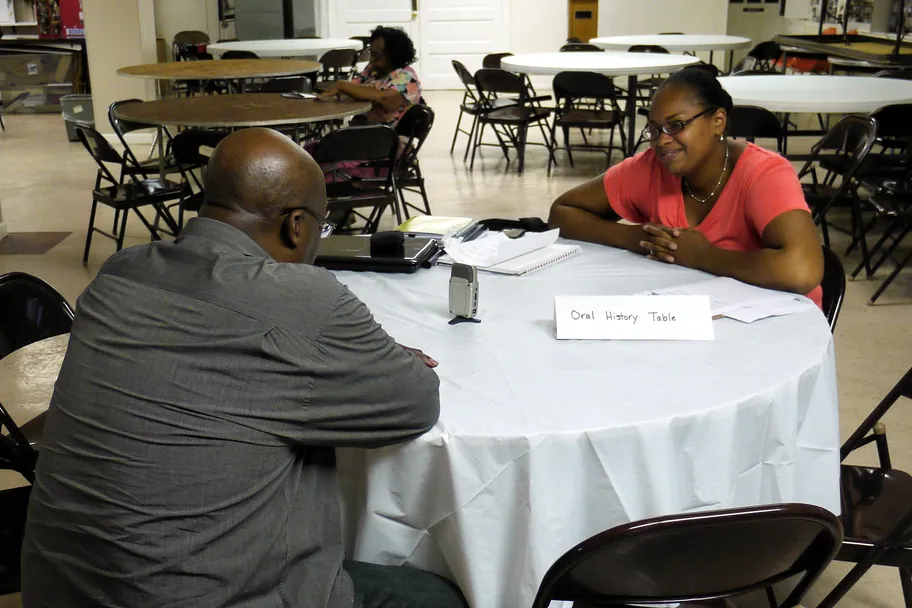
- Oral history programs. Recording a community’s memories well requires consent, release forms, sound recording, transcription and an archive partner. Our step-by-step guide to planning a community oral history project shows how many moving parts there are.
- Exhibits and public programs. A museum display, a commemorative event or a series like the ideas in our Black History Month program guide is only as strong as the research behind it.
- Preservation, compliance and planning. National Register nominations and compliance projects, both named by the NCPH, require documented research that will hold up to review.
- Curriculum and teaching materials. Schools and community organizations may want local history lessons built on primary sources and tied to their own neighborhood.
- Research for decisions. Sometimes an organization simply needs to know what happened, whether about a property, a policy or a dispute, before it acts.
When is it time to bring in outside help?
Some projects can be done well by a committee of dedicated volunteers. Bring in a history consultant when one or more of these is true:
- The work will be published, displayed or relied on in a legal or regulatory setting.
- The sources are scattered across archives, or the people who remember the events are aging.
- The project involves recorded interviews that must be handled ethically and archived.
- The subject is sensitive, and an independent voice will be more credible than an internal one.
Independence matters more than many clients expect. The NCPH Code of Ethics asks public historians to “exercise independent professional judgment” on behalf of a client and to maintain exclusive supervision over the research. The American Historical Association’s Statement on Standards of Professional Conduct asks historians not to omit evidence that runs counter to their own interpretation. A good consultant will tell you what the record shows, including the parts that complicate the story you hoped to tell.
How does an engagement with a history consultant work?
Expect the work to be defined in writing before it starts. The National Park Service, whose staff supervise oral history research completed by contractors and partners, publishes a checklist of what a scope of work should include, and its structure is a useful model for any history project.
- Scoping conversation. You describe the purpose, audience, deadline and any sources you already hold. The consultant asks questions and may look at the material before proposing anything.
- Written proposal and scope of work. The NPS checklist covers standards to follow, background research, a survey of existing interviews and collections, a plan for preserving materials, and defined deliverables such as recordings, transcripts, release forms and a final report.
- Research and fieldwork. Archival research, interviews and site visits happen here. Under the NCPH code, you decide the objectives and the nature of the services, while the consultant supervises the research and exercises independent judgment.
- Drafts and review. You review drafts for accuracy and fit. Corrections of fact are welcome; requests to drop inconvenient evidence are not something a professional historian should accept.
- Delivery and archiving. The finished product is delivered along with the research files, and interviews and other materials go to the agreed repository.
The NCPH code also covers the relationship itself. A consultant should not take on work beyond their competence, should disclose any actual or apparent conflict of interest in writing, and should keep information confidential when a client asks, subject to the exceptions the code sets out.
Who owns the work when the project is done?
Settle ownership before work begins. The U.S. Copyright Office’s Circular 30 explains that a commissioned work is a “work made for hire” only if it meets four criteria: it falls within one of nine listed categories, there is a written agreement, the agreement expressly calls it a work made for hire, and all parties sign it. If any requirement is missing, it is not a work made for hire.
The practical lesson is simple. Your contract should state who will own the finished book, report or exhibit text, the research notes and copies, and any recordings and transcripts. For oral histories, the NPS adds that when contractors conduct interviews, the contract should note the transfer of rights, and narrators and interviewers should both sign release forms.
What should you ask before you hire a historian?
The NCPH directory for consultants invites potential clients to request “work proposals, resumes, samples of work, or references.” Use those materials to answer these questions:
- What is your training? For federal preservation work, the NPS Professional Qualifications Standards, previously published at 36 CFR Part 61, set minimum qualifications in history. For other projects, look for advanced training in history and experience close to your subject.
- Can we see similar work and speak with past clients? Ask for samples and references from projects like yours.
- Which professional standards do you follow? Listen for the NCPH Code of Ethics, the AHA Statement on Standards of Professional Conduct and, for interviews, the Oral History Association’s best practices.
- How will you handle evidence that complicates our story? The answer should reflect the AHA’s call to report findings accurately and not omit contrary evidence.
- What exactly will we receive, and when? Ask for deliverables and milestones in writing.
- Who will own the results? Cover the finished work, research files and recordings.
- Do you have any conflicts of interest? Under the NCPH code, any conflict should be disclosed in writing.
- How will the community be involved? For projects about a neighborhood or congregation, ask how residents will shape the work and how narrators will be treated.
Where do you find a historical consultant?
The NCPH maintains a Consultants Directory of members who present themselves as historical consultants, searchable by name, years of experience, degree, region and areas of expertise. Its job board also posts job opportunities and requests for proposals, so an organization can publish its own request and compare the responses.
For a project rooted in Cleveland or Cuyahoga County, local knowledge saves time. A consultant who already knows the collections and the community will spend less of your project learning where to look. For more on the wider field, see our introduction to what public history is.
Why does the choice matter now?
Sooner or later, every organization has to explain where it came from and whom it has served. A well-researched history, accurately told, can guide decisions, strengthen relationships and outlast the people who lived it. A poorly researched one can embarrass the very institution it was meant to honor.
Mays HisToracle Consulting, led by Nick Mays, Ph.D., provides historical research, oral history project design, interviews, curriculum development and public talks for nonprofits, companies, government agencies, community institutions and families.
Questions people ask
What is the difference between a historical consultant and a heritage consultant?
The titles overlap. The National Council on Public History notes that public historians call themselves historical consultants, cultural resource managers, oral historians, historic preservationists and many other names. Rather than relying on the title, ask what the person actually does, whether archival research, interviews, preservation documentation, exhibits or writing. Training, samples of past work and references tell you more than a job title does.
Do I need a historian with a Ph.D.?
Not always; match the credentials to the stakes. For federal historic preservation work, the National Park Service sets minimum qualifications in history of a graduate degree in history or a closely related field, or a bachelor’s degree plus two years of full-time professional experience or a substantial record of research and publication. For a published history or a contested question, advanced training and a track record matter more.
Who owns the research a consultant produces?
Settle it in the contract. Under the U.S. Copyright Office’s Circular 30, a commissioned work counts as a work made for hire only if it fits one of nine categories and both parties sign a written agreement expressly calling it one. Otherwise, the author is ordinarily the person who created the work. Put in writing who will own the finished product, research files, recordings and release forms.
Can a consultant work alongside our volunteers?
Yes. A consultant can design the plan, train volunteer interviewers, set standards for release forms and archiving, and review the results, while members of your organization lead outreach and recruiting. The Oral History Association encourages community projects to consider a formal engagement plan, which might include a community advisory board, oral history training for residents and public events that share what the project finds.
Sources
- About the Field, National Council on Public History.
- For Consultants, National Council on Public History.
- Code of Ethics and Professional Conduct, National Council on Public History.
- Statement on Standards of Professional Conduct, American Historical Association.
- Professional Qualifications Standards, National Park Service.
- Circular 30: Works Made for Hire, U.S. Copyright Office.
- Case Study: Writing a Scope of Work for an Oral History Project, National Park Service.
- OHA Best Practices, Oral History Association.