Researching Cleveland History: The Archives, Collections and Newspapers Worth Knowing
A guide to researching Cleveland history: which archives, libraries, newspapers and oral history collections to use, and how to get access to each one.
The best starting points for researching Cleveland history are the Encyclopedia of Cleveland History and Cleveland Historical for background, Cleveland Public Library and Cleveland State University’s Cleveland Memory for photographs and newspapers, Cleveland Voices for oral history, and the Western Reserve Historical Society and Cuyahoga County Archives for manuscripts and public records. The Plain Dealer and the Cleveland Call and Post can be searched through library databases with a public library card, which Cleveland Public Library and Cuyahoga County Public Library both offer to Ohio residents.
This guide explains what each collection holds, how to get access, and which questions it answers best. It is written for family historians, teachers, students and community groups working on the history of Cleveland and Cuyahoga County. Hours and access rules change, so confirm with each institution before you visit.
The steps at a glance
- Read the background in the Encyclopedia of Cleveland History and Cleveland Historical.
- Get a library card from Cleveland Public Library or Cuyahoga County Public Library.
- Search the newspapers: the Plain Dealer, the Call and Post and the Cleveland Press.
- Find photographs at Cleveland Public Library and in Cleveland Memory.
- Listen to oral histories in Cleveland Voices.
- Use manuscripts and family records at the Western Reserve Historical Society.
- Use public records at the Cuyahoga County Archives.
- Widen the search to statewide and national collections.
Step 1: Where should you start researching Cleveland history?
Start with reference works that give you names, dates, spellings and the vocabulary you will need for every later search. The Encyclopedia of Cleveland History, from Case Western Reserve University, draws on the contributions of hundreds of academic scholars and amateur historians. It appeared in two printed editions, in 1987 and 1996, and continues as an ongoing web edition.
Cleveland Historical is a project of the Center for Public History + Digital Humanities at Cleveland State University, formed in 2007. It presents stories about Cleveland places, which can be browsed as tours or on a map. Treat both as maps to the evidence, not the end of the trail: when they disagree on a date or a count, as they sometimes do, the primary sources below are where you settle it.
Step 2: Why do you need a library card?
Most historical newspaper databases are licensed to library cardholders, so a card is the key that opens them. Cleveland Public Library cards are free to permanent Ohio residents and to people who go to school, work on a permanent basis or own property in Ohio. If you cannot visit in person, the library offers an eCard online for electronic content, including research databases.
Cuyahoga County Public Library states that every Ohio resident of any age is eligible for a card, and verified adult applicants who apply online get instant access to its electronic resources. Cleveland Public Library notes that a Cuyahoga County Public Library card must first be activated by Cleveland Public Library or CLEVNET before it can be used for their resources.
Step 3: How do you search old Cleveland newspapers?
Newspapers are the backbone of most Cleveland history research, from obituaries to building openings. These are the runs to know.
- The Plain Dealer. Cleveland Public Library offers Plain Dealer Historical, covering 1845 to 1991, to cardholders, plus full-text databases for 1991 to the present. Cuyahoga County Public Library offers a Plain Dealer resource covering every issue from April 7, 1845, through today.
- The Cleveland Call and Post. Long Cleveland’s major African American newspaper, it formed in the 1927 merger of the Call and the Post. The inventor Garrett A. Morgan helped found the Call about 1920. Cleveland Public Library and Cuyahoga County Public Library provide the 1934 to 1991 run.
- The Cleveland Press. The Press was Cleveland’s evening newspaper from 1878 to 1982. In March 2025 Cleveland State University announced it had digitized the paper with Newspapers.com. Free access is campus-only, with one library workstation for outside researchers, and the university expects wider access after a three-year embargo.
- Death notices. Cleveland Public Library’s Cleveland Necrology File holds local cemetery records and newspaper death notices for 1833, 1847 to 1848 and 1850 to 1975.
For the history of Black Cleveland, including the migration from the South described in our article on the Great Migration to Cleveland, the Call and Post is a core source. Read it alongside the daily papers to see how the same people and events were reported to different readers.
Step 4: Where can you find historical photographs of Cleveland?
Cleveland Public Library’s Photograph Collection holds more than 1.4 million photographs, mostly black and white, from the 1850s to the present. They are drawn primarily from local newspaper morgues and photograph archives, and the collection is in the Louis Stokes Wing of the Main Library, on the fourth floor.
Cleveland Memory, sometimes called the Cleveland Memory Project, was launched in 2002 by the Michael Schwartz Library at Cleveland State University with community partners around Northeast Ohio. It is a free, searchable online collection of digital photographs, texts, oral histories and videos, and its holdings include the Cleveland Press Collection of 500,000 photographs and the Cleveland Union Terminal Collection on the building of the Terminal Tower project.
Two notes on the rest of the Main Library. The Center for Local and Global History, on the sixth floor of the Louis Stokes Wing, collects city directories, histories of Cleveland and histories of its neighborhoods and ethnic communities. Special Collections, on the third floor, focuses on chess and checkers, folklore, and the peoples and histories of Africa, Oceania and Asia, so it is rarely the first stop for neighborhood history. Before you publish any photograph, read its rights statement, because many images online are not in the public domain.
Step 5: What can oral histories in Cleveland Voices add?
Oral histories can record what documents leave out: how a neighborhood felt, why a family moved and who held a community together. Cleveland Voices is the online archive of the Center for Public History + Digital Humanities at Cleveland State University, which has collected oral history interviews since 2002. Interviews are organized into collections, with research guides on themes such as the African American experience.
One example is the East Cleveland collection of 25 transcribed interviews, recorded in 2025 for the East Cleveland Oral History Project, directed by Dr. Nicholas S. Mays in partnership with the Cuyahoga Land Bank. Cleveland Voices shares its interviews under a Creative Commons BY-NC-SA license and advises that “Listeners are encouraged to verify stories through additional research.” Our explainer on what oral history is covers how to use interviews as evidence.
Step 6: What does the Western Reserve Historical Society hold?
The Western Reserve Historical Society Library is housed in the Cleveland History Center at 10825 East Boulevard in University Circle. Its collections include 250,000 books, 25,000 newspapers, maps and other printed material, over 10,000 linear feet of processed personal papers and records, and more than 340,000 images. It is a FamilySearch Affiliate Library, with family history materials such as church records, funeral home records and family bibles.
The library welcomes individual researchers and groups by appointment, and asks visitors to contact the reference staff in advance. As of October 2026, its posted public hours are Thursday through Saturday, 10 a.m. to 3 p.m. Its digital collections are available online through its portal, Digital Cleveland Starts Here.
Step 7: What public records are at the Cuyahoga County Archives?
The Cuyahoga County Archives, at 3951 Perkins Avenue in Cleveland, keeps the county’s historical public records. Its posted office hours are Monday through Friday, 8:30 a.m. to 3 p.m., and no new records may be requested after 2:45 p.m. Property research is by appointment only, and copies can also be requested by email or postal mail.
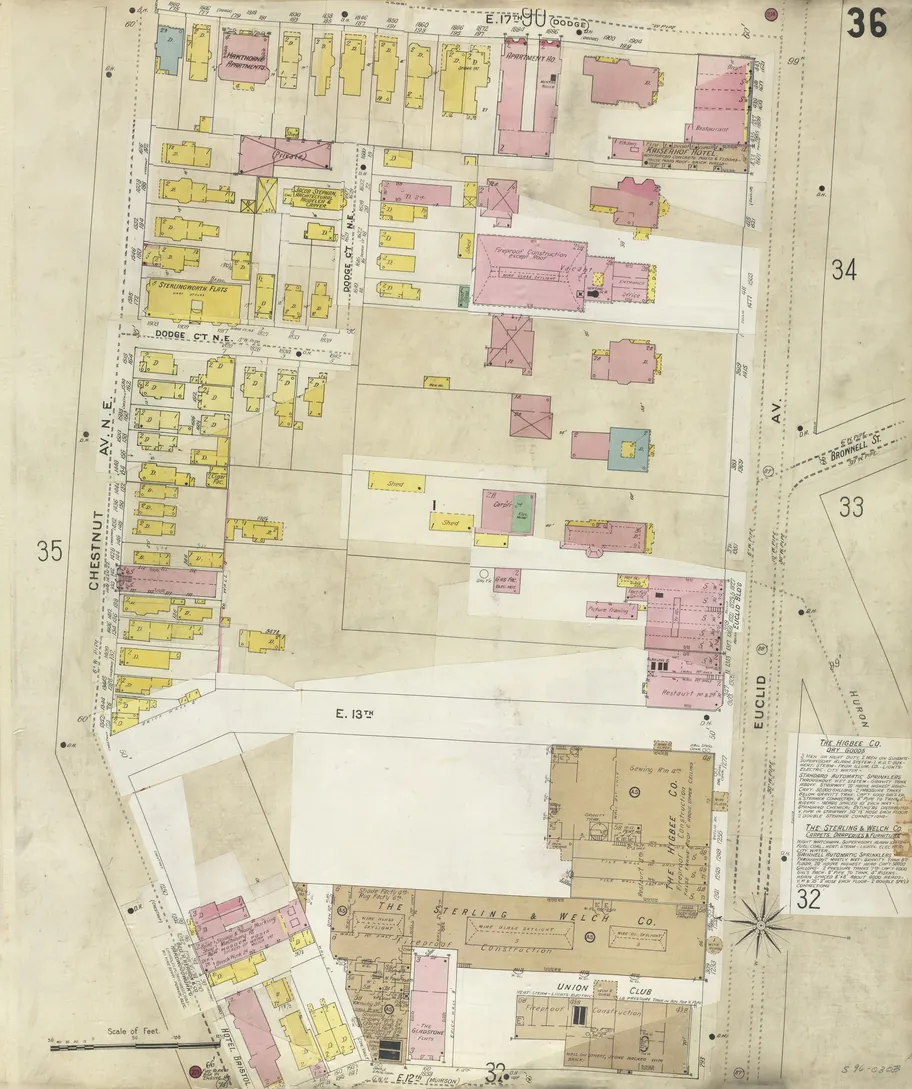
The archives’ own list of holdings includes Board of County Commissioners journals from 1810 to 1985, birth records from 1849 to 1908 (not inclusive), death records from 1840 to 1908, marriage records from 1810 to 1941 with an index to the present, naturalization records from 1818 to 1971, Probate Court estate files from 1813 to 1918, Cleveland city directories from 1837 to 1972 (not inclusive), real estate appraisal cards from about 1935 to 1970, tax records from about 1819 to 1986, plat maps from about 1890 to 1945, and county atlases from 1852, 1874, 1892 and 1903. If you are tracing a building, our guide to researching the history of a house shows how these records fit together.
Step 8: Where else should you look beyond Cleveland?
The Ohio History Connection’s Archives & Library is at 800 East 17th Avenue in Columbus. It says that most of its collections are not digitized: a small number of items are online through Ohio Memory, and many records, especially public records, exist only on paper or microfilm. Researchers are asked to register for a free Archives & Library card, and personalized research appointments are available.
At the national level, the Library of Congress and the National Endowment for the Humanities run the National Digital Newspaper Program, whose Chronicling America site lets you search digitized newspaper pages and find information about American newspapers published from 1690 to the present. Its directory is a useful way to learn which newspapers were published in a given place and period.
Why does careful Cleveland history research matter now?
The history of Cleveland is being retold constantly, in anniversaries, neighborhood plans, school projects and online posts, and not everything that circulates has been checked against the record. Going back to the newspapers, records, photographs and voices themselves is how families, congregations and community groups get their own stories right and add what earlier histories left out.
Mays HisToracle Consulting helps organizations, families and communities plan and carry out historical research in these collections and many others.
Questions people ask
Where can I read old Cleveland Plain Dealer articles for free?
Use a public library card. Cleveland Public Library offers Plain Dealer Historical, covering 1845 to 1991, to its cardholders, along with databases for later years. Cuyahoga County Public Library offers a Plain Dealer resource covering every issue from April 7, 1845, to today. Cuyahoga County Public Library cards are open to every Ohio resident, and Cleveland Public Library cards are free to permanent Ohio residents.
How can I access the Cleveland Call and Post archive?
Cleveland Public Library offers cardholders full-text searching of every issue of the Cleveland Call and Post published from 1934 to 1991, and notes that later issues are indexed or available in full text through Ethnic Newswatch. Cuyahoga County Public Library also provides the 1934 to 1991 run. The paper was formed in 1927 by the merger of two weeklies, the Call and the Post.
What is the Cleveland Memory Project?
Cleveland Memory, launched in 2002, is a free, searchable online collection of digital photographs, texts, oral histories, videos and other local history resources, built by the Michael Schwartz Library at Cleveland State University with community partners. Its holdings include the Cleveland Press Collection of 500,000 photographs. The Cleveland Press itself was digitized with Newspapers.com in 2025, with free access limited at first to the CSU campus.
What is Cleveland Voices?
Cleveland Voices is the online oral history archive of the Center for Public History + Digital Humanities at Cleveland State University, which has collected interviews since 2002. Interviews are grouped into collections, such as the East Cleveland collection of 25 transcribed interviews recorded in 2025, and are shared under a Creative Commons BY-NC-SA license. The site encourages listeners to verify stories through additional research.
Sources
- About the Encyclopedia of Cleveland History, Encyclopedia of Cleveland History, Case Western Reserve University.
- About Cleveland Historical, Cleveland Historical, CSU Center for Public History + Digital Humanities.
- Library Cards, Cleveland Public Library.
- Get a card, Cuyahoga County Public Library.
- Databases, Cleveland Public Library.
- Plain Dealer, The (Cleveland, OH), Cuyahoga County Public Library.
- Cleveland Call & Post, Cuyahoga County Public Library.
- Cleveland Call & Post, Encyclopedia of Cleveland History, Case Western Reserve University.
- News from Cleveland Memory: The Cleveland Press is Digitized at Last! (March 24, 2025), Michael Schwartz Library, Cleveland State University.
- About Cleveland Memory, Michael Schwartz Library, Cleveland State University.
- Photograph Collection, Cleveland Public Library.
- Center for Local and Global History, Cleveland Public Library.
- Special Collections, Cleveland Public Library.
- Cleveland Voices, CSU Center for Public History + Digital Humanities.
- East Cleveland (25 transcribed interviews), Cleveland Voices, CSU Center for Public History + Digital Humanities.
- WRHS Library: About, Western Reserve Historical Society.
- WRHS Library: Services, Western Reserve Historical Society.
- Hours and Admission, Western Reserve Historical Society.
- Archives, Cuyahoga County Department of Public Works.
- Archives: Get Started, Cuyahoga County Department of Public Works.
- Archives: Policies and Procedures, Cuyahoga County Department of Public Works.
- Archives & Library Welcome Guide, Ohio History Connection.
- Archives & Library FAQs: Visit, Ohio History Connection.
- National Digital Newspaper Program, Library of Congress.