How to Research the History of Your House in Cleveland and Cuyahoga County
To find the history of my house in Cuyahoga County, start with the county’s online deed search, then use Sanborn maps, city directories and census records.
To research the history of your house in Cleveland or anywhere in Cuyahoga County, start with the county’s own records: look up the parcel on MyPlace, then trace the deeds back through the Fiscal Officer’s Recorded Document Search, which covers 1810 to the present. Next, estimate the construction date with tax records and historic maps, and learn who lived there from city directories, the census, building permits, photographs and newspapers.
Homeowners who wonder about the history of my house, and organizations that need to know how to find the history of a building, can follow the same path. Each step below names the office or library that holds the record. Hours and addresses change, so confirm them before you visit.
How do you research the history of your house in Cuyahoga County?
Begin with what you already have. The Cuyahoga County Archives advises starting every property search with two pieces of information: the street address and the parcel number.
-
Find the parcel number. It appears on your deed, your tax bill or a reappraisal notice, according to the Archives. You can also search the county’s MyPlace site by owner, parcel number or address for any municipality in Cuyahoga County. Write down the parcel number, the current owner and the legal description, which you will match against older records.
-
Trace the owners through the deeds. The Fiscal Officer’s Recorded Document Search covers recorded documents “from 1810 to present, including deeds.” Search by name or parcel, then work backward one sale at a time, noting each buyer, seller and date. The Fiscal Officer’s recorded documents office is at 2079 East Ninth Street, fourth floor, and is open weekdays from 8:30 a.m. to 4:30 p.m. (216-443-7420).
-
Ask the County Archives to fill the gaps. The Cuyahoga County Archives, at 3951 Perkins Avenue, offers property research by appointment, weekdays from 8:30 a.m. to 3 p.m. (216-443-7250). It holds the older tax records and map volumes described below.
How do you find the history of a building’s construction date?
Few houses come with a reliable birth certificate. Historians date buildings by comparing several kinds of evidence until they agree.
-
Read the tax records. The Archives holds Cuyahoga County tax records from 1819 to 1986; records from 1987 to the present are online. Its advice is precise: “cross reference those names with tax duplicates to track changes in property values. Significant increases in these values suggest construction dates.” A lot that jumps in value from one year to the next probably gained a building.
-
Compare historic maps. The Archives holds county map volumes from about 1860 to 1945, with later volumes in the Fiscal Office Map Room, plus City of Cleveland map volumes for 1870, 1880 and 1890 and county atlases for 1852, 1874, 1892 and 1903. On these maps, a small box or outline marks a building. If your house is missing from one atlas and present on the next, it was likely built in between.
The Cleveland Public Library’s Map Collection, on the sixth floor of the Louis Stokes Wing at 525 Superior Avenue, holds more than 50,000 maps and 6,000 volumes. It began in 1884 with 122 maps from John G. White. The library notes that “the first City of Cleveland Sanborn Maps were published in 1874 and the last in 1973,” and its G. M. Hopkins plat books show owner names. The collection is reference only, so plan to work on site or in the library’s online Digital Gallery.
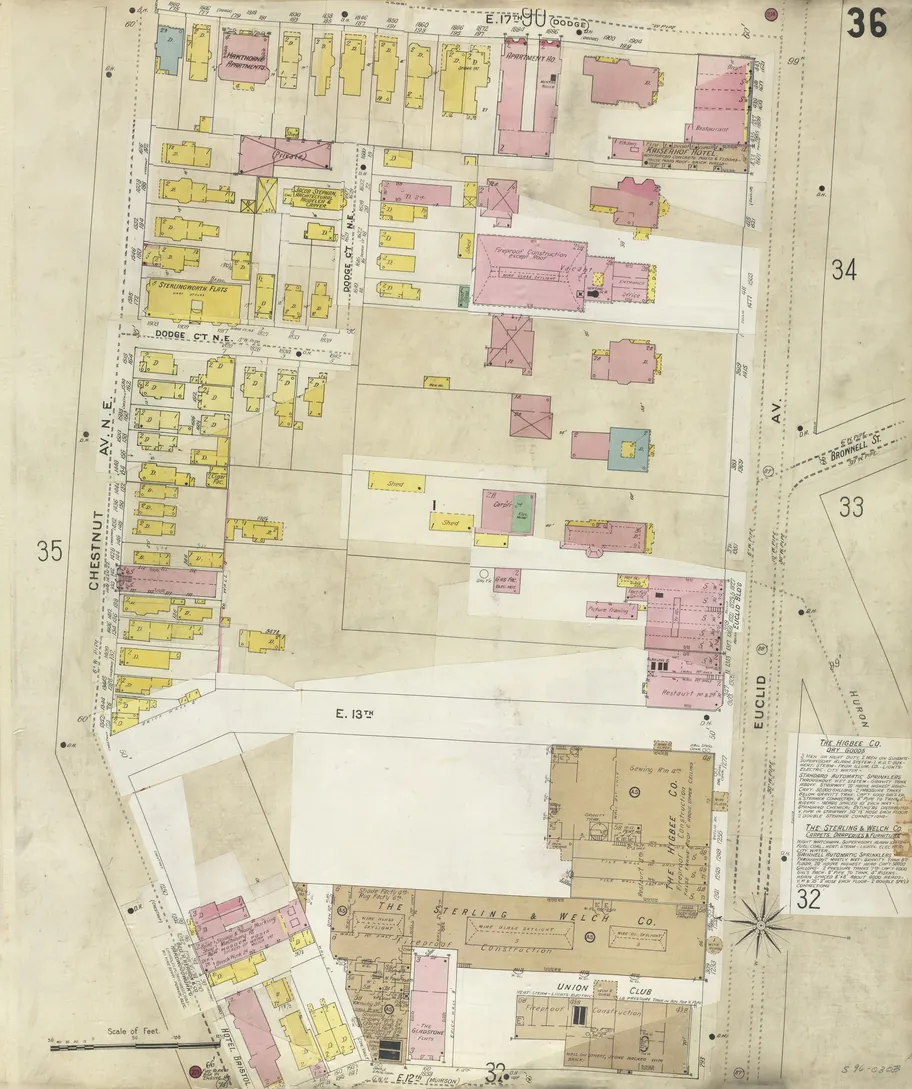
The Ohio Web Library’s Sanborn collection, available online through Ohio libraries, offers “over 40,000 detailed maps of Ohio cities drawn between 1882 and 1962” in black and white. To read a colored Sanborn sheet like the one above, use the Library of Congress key: pink or red for brick, yellow for frame, blue for concrete or cinder block, olive for fire resistive construction and gray for adobe or metal, with D for dwelling and S for store.
- Check the building permits. In the City of Cleveland, the Department of Building and Housing’s Records Administration handles “all building and commercial permits,” at 601 Lakeside Avenue, Room 517. The city adds a fair warning: “If the owner doesn’t pull a permit to perform work, the City may not have an accurate history.” If your house sits in one of the county’s other municipalities, ask that city’s building department.
How do you find out who lived in your house?
Deeds name owners. Directories and the census name the people who actually lived there, including renters.
-
Search the city directories. According to the Cleveland Public Library’s guide, the first Cleveland city directory appeared in 1837 and the last for the city proper in 1977, and the full set is on microfilm. The criss-cross section, arranged by street address, begins with the 1929 edition, which lets you look up a house rather than a person. Suburban directories cover 1924 to 1963. The library’s Center for Local and Global History can help (clgh@cpl.org).
-
Find the household in the census. The federal census has been taken every ten years since 1790. Individual records stay closed for 72 years, so the most recent census open to the public is 1950, released by the National Archives on April 1, 2022. Find your address in each census from 1950 back, and you can watch the household change from one decade to the next.
Where can you find photographs and stories of your house?
-
Look for photographs. The Cleveland Public Library’s Photograph Collection, on the fourth floor of the Louis Stokes Wing, holds more than 1.4 million photographs, over 400,000 of them of northeast Ohio. Staff help with requests ranging “from locating images of family homes to in-depth topical searches.”
-
Search the newspapers. The Cleveland Press, published from 1878 to 1982, has been digitized through Newspapers.com, though Cleveland State University’s library notes that “initial access to the digitized archive is limited.” Search your street address as well as the names of past owners.
-
Check landmark and architect records. The Cleveland Landmarks Commission oversees more than 300 landmarks and 29 historic districts, and its website offers a Historic Cleveland Architects Database and an interactive map. The Western Reserve Historical Society’s research library, at 10825 East Boulevard, holds 250,000 books, more than 340,000 images and more than 10,000 linear feet of manuscripts, and serves visitors by appointment. If your house stands on a famous street, our history of Millionaires’ Row on Euclid Avenue shows what that research can yield.
-
Talk to the people who remember. Former owners, longtime neighbors and the families of past residents often know what no record says: who built the porch, when the corner store closed, why the house was divided. Record those conversations with permission. Our questions to ask your grandparents work well with former residents too.
For a wider map of local repositories, see our guide to Cleveland history archives.
Why the history of your house matters now
A house is a record of the people who built, owned, rented and repaired it. Across Cleveland and Cuyahoga County, homes are being sold, renovated and demolished every year, and the documents that explain them are easiest to find while the people who remember them can still help.
Mays HisToracle Consulting offers historical research for homeowners, families and organizations who want the full story of a house or building.
Questions people ask
How can I find out when my house was built in Cuyahoga County?
Compare the tax records year by year. The Cuyahoga County Archives advises researchers to cross-reference owners’ names with tax duplicates, because a significant increase in a property’s value suggests a construction date. Confirm the result with historic maps: a house that appears on one map volume but not on an earlier one was built between the two. The Archives holds tax records from 1819 to 1986.
Are Cuyahoga County deeds online?
Yes. The Cuyahoga County Fiscal Officer’s Recorded Document Search covers recorded documents from 1810 to the present, including deeds, and can be searched online. You can also look up any parcel by owner, parcel number or address on the county’s MyPlace site. For older deeds or help reading them, the Cuyahoga County Archives offers property research by appointment at 3951 Perkins Avenue.
What do the colors on a Sanborn map mean?
The Library of Congress explains that Sanborn maps use color to show building materials: pink or red for brick, yellow for frame, blue for concrete or cinder block, olive for fire resistive construction, and gray for adobe or metal. Letters mark use, such as D for dwelling and S for store. The Ohio Web Library’s Sanborn maps are black and white, so read the labels there instead.
Can I see a photograph of my house from decades ago?
Possibly. The Cleveland Public Library’s Photograph Collection holds more than 1.4 million photographs, over 400,000 of them of northeast Ohio, and its staff help with requests ranging from locating images of family homes to in-depth topical searches. Newspapers are another source: the Cleveland Press, published from 1878 to 1982, has been digitized, though Cleveland State University notes that initial access is limited.
Sources
- Recorded Documents, Cuyahoga County Fiscal Officer.
- MyPlace, Cuyahoga County.
- Property Research, Cuyahoga County Archives.
- Map Collection, Cleveland Public Library.
- Guide to City Directories, Criss-Cross Directories and Telephone Directories, Cleveland Public Library.
- Photograph Collection, Cleveland Public Library.
- Sanborn Maps: About This Collection, Library of Congress.
- Sanborn Fire Insurance Maps, Ohio Web Library.
- Records Administration, City of Cleveland, Department of Building and Housing.
- Cleveland Landmarks Commission, City of Cleveland.
- 1950 Census, National Archives.
- News from Cleveland Memory: The Cleveland Press is Digitized at Last!, Michael Schwartz Library, Cleveland State University.
- About the WRHS Library, Western Reserve Historical Society.
- Library Services, Western Reserve Historical Society.