Millionaires’ Row: Euclid Avenue from Cleveland to East Cleveland
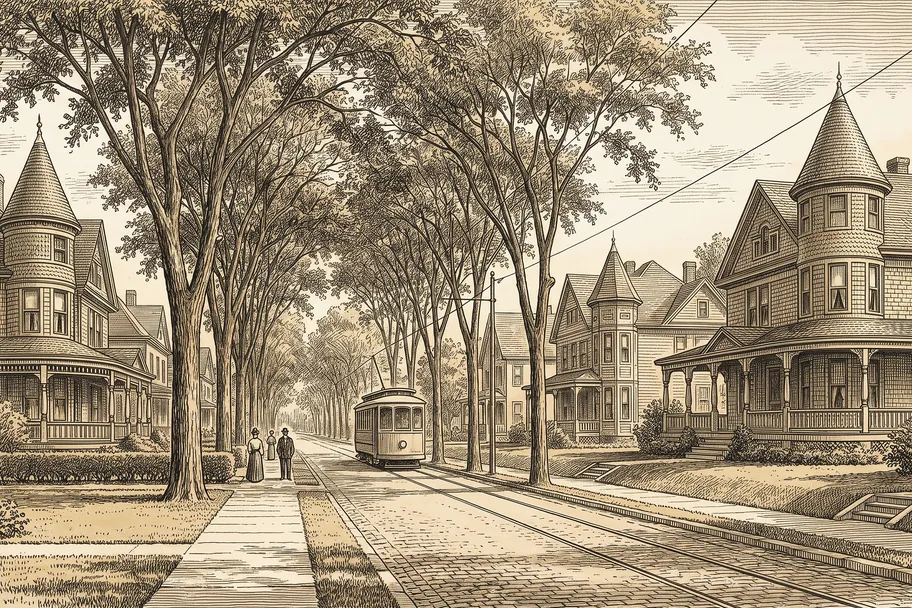
Millionaires’ Row was the stretch of Euclid Avenue in Cleveland lined with the mansions of the city’s wealthiest families in the late 1800s and early 1900s.
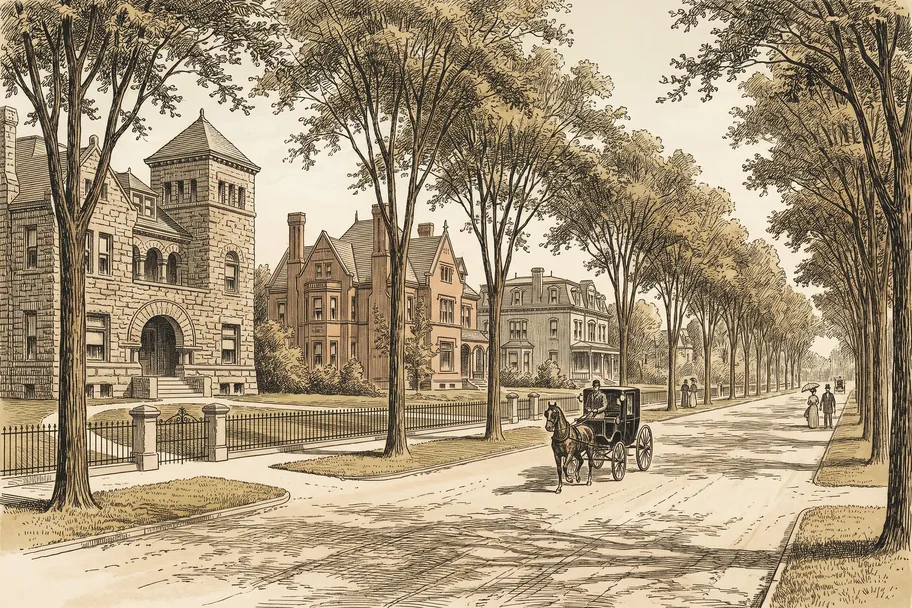
Millionaires’ Row was the stretch of Euclid Avenue in Cleveland where the city’s wealthiest families built mansions on deep lawns in the late nineteenth and early twentieth centuries, centered between East 9th and East 55th streets. Commerce pushed the families out in the early twentieth century, most of the houses were demolished, and Euclid Avenue itself runs on past the old row to East Cleveland, where John D. Rockefeller kept his summer estate.
This guide to Millionaires’ Row draws on the Encyclopedia of Cleveland History and Cleveland Historical, the public history project of Cleveland State University. Where they differ, on boundaries or on how many houses there were, we say so.
At a glance
- Euclid Avenue was laid out by Cleveland village trustees in 1815 and gained official avenue status in 1870.
- The first great mansions rose between Erie Street (East 9th) and Willson Avenue (East 55th).
- John D. Rockefeller bought a home on Euclid Avenue in 1868 and lived there until 1884.
- The 45-room Samuel Mather Mansion, completed in 1910, was among the last mansions built on the avenue.
- By 1937, of the 40 great houses that had formed Millionaires’ Row, 7 remained standing, according to the Encyclopedia of Cleveland History.
What was Millionaires’ Row in Cleveland?
Euclid Avenue follows the historic Lake Shore Trail. Cleveland village trustees laid it out in 1815, and as late as 1825 it was still called the Buffalo Road. The state recognized it as a highway in 1832, and Dunham Tavern, now a museum, served as a stagecoach stop along the route.
Along the stretch between Erie Street (East 9th) and Willson Avenue (East 55th), Cleveland’s wealthiest men began building mansions set back on spacious lawns. The street became an official avenue in 1870. The Encyclopedia of Cleveland History reports that it was claimed no avenue in the world presented such a “continuous succession of charming residences and such uniformly beautiful grounds.” In the 1870s, fine homes began filling the open land east of Willson Avenue as well.
Who lived on Millionaires’ Row?
The best-known resident was John D. Rockefeller, who bought a home on Euclid Avenue in 1868 and lived there until he moved to New York City in 1884. Cleveland Historical also names Marcus Hanna and Charles F. Brush among the prominent figures who built there. The streetcar magnate Tom L. Johnson, Cleveland’s mayor from 1902 to 1909, owned a much larger mansion almost directly across the street from the Howe house described below.
The architect Charles F. Schweinfurth shaped much of the street’s look. The Encyclopedia of Cleveland History credits him with “no fewer than 15” mansions on Euclid Avenue, while Cleveland Historical says “at least twelve,” so the safe statement is more than a dozen. Many were in the heavy Romanesque style that suited the city’s industrialists and financiers.
The last great houses came in the early 1900s. The Encyclopedia of Cleveland History names the Leonard C. Hanna house (1904) and the Samuel Mather house (1910) as among the last. Mather, chairman of the iron ore shipping firm Pickands, Mather and Company, commissioned Schweinfurth to design a 45-room house at 2605 Euclid Avenue. Cleveland Historical describes it as the most expensive home in Cleveland when it was completed, with a third-floor ballroom that could hold 300 guests.
Which Millionaires’ Row mansions still stand?
A few houses survive, most of them on the Cleveland State University campus. The Mather Mansion passed to the Cleveland Institute of Music after Mather’s death in 1931 and to the Cleveland Automobile Club in 1940. Cleveland State acquired it in 1967, and six years later it was listed on the National Register of Historic Places.
The George Howe Mansion at 2300 Euclid Avenue also survives. Howe, a businessman who later served as police commissioner, built it in 1894 on the south side of the avenue, where houses were generally smaller and sat on smaller lots. Cleveland State bought it in 1983 and renamed it Parker-Hannifin Hall in 2005. If you are tracing a surviving house or the site of a lost one, our guide to researching the history of a house explains how to work with deeds, atlases and city directories.
Why did Millionaires’ Row disappear?
Downtown grew straight up Euclid Avenue. Between about 1890 and 1910, the section from Public Square to East 9th Street became a dense commercial district, and by the early 1920s the theaters of Playhouse Square had carried downtown east to East 17th Street. Wealthy families moved east to the Wade Park Allotment and to suburbs such as Cleveland Heights and Shaker Heights.
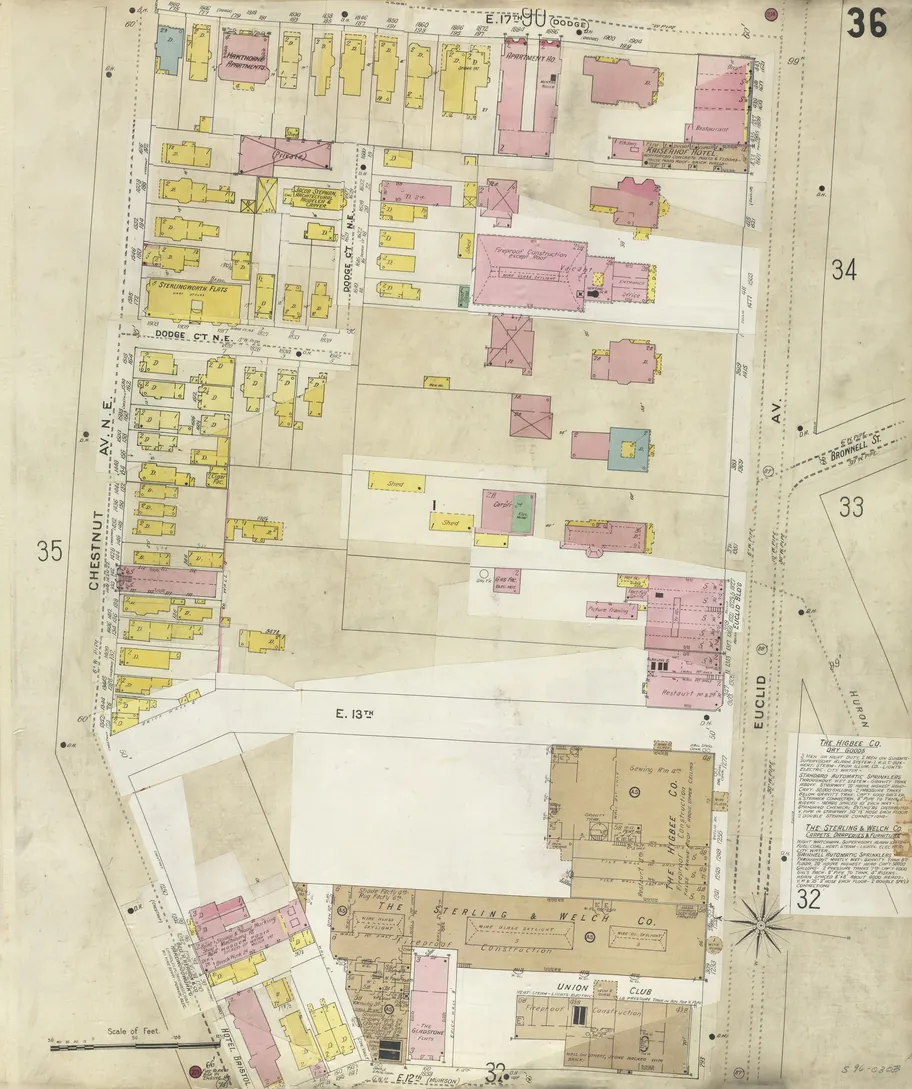
The houses they left behind were converted to rooming houses and institutional uses, and used car lots opened in front of more than one mansion. Cleveland Historical reports that many homes on the row were demolished between 1923 and 1951, and in the mid-1950s the homes between the Mather Mansion and East 30th Street were cleared for the Innerbelt Freeway. More came down as Cleveland State’s campus expanded.
How many houses were on Millionaires’ Row?
There is no single answer, because the sources define the row differently. The Encyclopedia of Cleveland History writes that “by 1937, of the 40 great houses that had formed ‘Millionaires’ Row,’ 7 remained standing.” Cleveland Historical notes that by 1975 the Mather Mansion was among only seven remaining homes of the row. Counting more broadly, a Cleveland Historical caption describes the Eells mansion, razed in 1959, as “just one of more than 300 grand residences along Euclid Avenue.” Any number should be read with its boundaries in mind.
How does Euclid Avenue connect Cleveland and East Cleveland?
Euclid Avenue does not stop at the old row. It continues past University Circle into East Cleveland, where Rockefeller assembled his Forest Hill summer estate after 1873, eventually about 700 acres reaching into Cleveland Heights. The family summered there until 1915, and the house burned in 1917. Our short history of East Cleveland follows what happened to the estate and the city around it.
In East Cleveland, Euclid Avenue went through a version of the same change. The Encyclopedia of Cleveland History reports that in the second half of the twentieth century, small businesses, motels and fast-food outlets replaced many Euclid Avenue homes there, and an influx of mortuaries into the houses that remained led to the nickname “Funeral Row.” The Healthline bus rapid transit corridor, completed in 2009, runs on Euclid Avenue from Public Square to East Cleveland. The same source reports billions of dollars of investment along much of the street, but little redevelopment in East Cleveland.
In Cleveland, the neighborhoods around the old row changed as well. Hough, which lies between Euclid and Superior avenues from East 55th to East 105th Street, went from 5 percent nonwhite in 1950 to 74 percent nonwhite in 1960. The Encyclopedia of Cleveland History reports that it became a relocation target when the city’s urban renewal programs displaced many African Americans in the mid-1950s. Our article on the Hough uprising of 1966 takes up that history.
Why does Millionaires’ Row matter now?
Millionaires’ Row shows how quickly wealth, commerce and transportation can remake a street, and how much of a city’s history survives only in photographs, atlases and a handful of buildings. Euclid Avenue is still being rebuilt, from Cleveland State’s campus to East Cleveland, and the story of who lived along it, and who came after, is part of every decision about its future.
Mays HisToracle Consulting researches the histories of buildings, neighborhoods and institutions for organizations and families across Cleveland and Cuyahoga County.
Questions people ask
Where was Millionaires’ Row in Cleveland?
Millionaires’ Row was a stretch of Euclid Avenue east of downtown Cleveland. The Encyclopedia of Cleveland History places the first mansions between Erie Street (East 9th) and Willson Avenue (East 55th), and Cleveland Historical describes the row as running from East 9th to East 55th Street. Fine homes also spread east of East 55th from the 1870s, so the boundaries depend on the source.
How many mansions were on Millionaires’ Row?
Counts depend on how the row is defined. The Encyclopedia of Cleveland History writes that by 1937, of the 40 great houses that had formed Millionaires’ Row, 7 remained standing. Cleveland Historical, counting more broadly, describes more than 300 grand residences along Euclid Avenue. The difference comes from boundaries and from what counts as a great house, so check how any total was defined.
Which Millionaires’ Row mansions still stand?
Only a few survive. The Samuel Mather Mansion at 2605 Euclid Avenue, completed in 1910, belongs to Cleveland State University and was listed on the National Register of Historic Places. The George Howe Mansion at 2300 Euclid, built in 1894, is now Cleveland State’s Parker-Hannifin Hall, which Cleveland Historical calls one of the last surviving Millionaires’ Row mansions.
Did John D. Rockefeller live on Millionaires’ Row?
Yes. The Encyclopedia of Cleveland History reports that John D. Rockefeller bought a home on Euclid Avenue in 1868 and lived there until he moved to New York City in 1884. His family’s summer estate, Forest Hill, was farther out along Euclid Avenue in East Cleveland, where the family spent summers until his wife Laura’s death in 1915.
Sources
- Euclid Ave., Encyclopedia of Cleveland History, Case Western Reserve University.
- Mather Mansion: A Remnant of Millionaires' Row, Cleveland Historical, CSU Center for Public History + Digital Humanities.
- Parker-Hannifin Hall: The Howe Mansion, Cleveland Historical, CSU Center for Public History + Digital Humanities.
- Eells Mansion on Millionaires' Row (image caption), Cleveland Historical, CSU Center for Public History + Digital Humanities.
- From Millionaires' Row to Campus District (tour), Cleveland Historical, CSU Center for Public History + Digital Humanities.
- Forest Hill, Encyclopedia of Cleveland History, Case Western Reserve University.
- East Cleveland, Encyclopedia of Cleveland History, Case Western Reserve University.
- Hough, Encyclopedia of Cleveland History, Case Western Reserve University.