East Cleveland, Ohio: A Short History of the City
East Cleveland, Ohio, became a village in 1895 and a city in 1911; this short history traces its growth, its change after 1950 and what residents built.
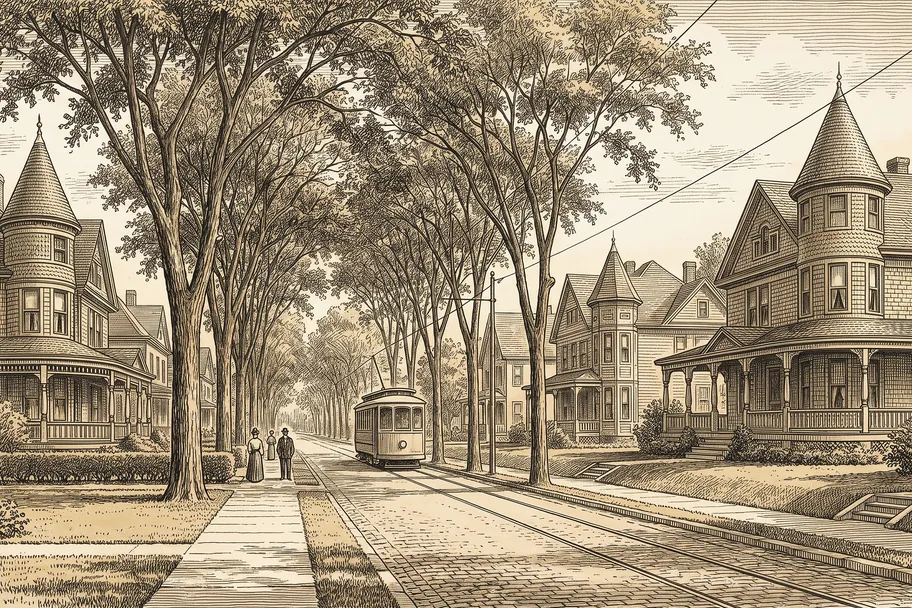
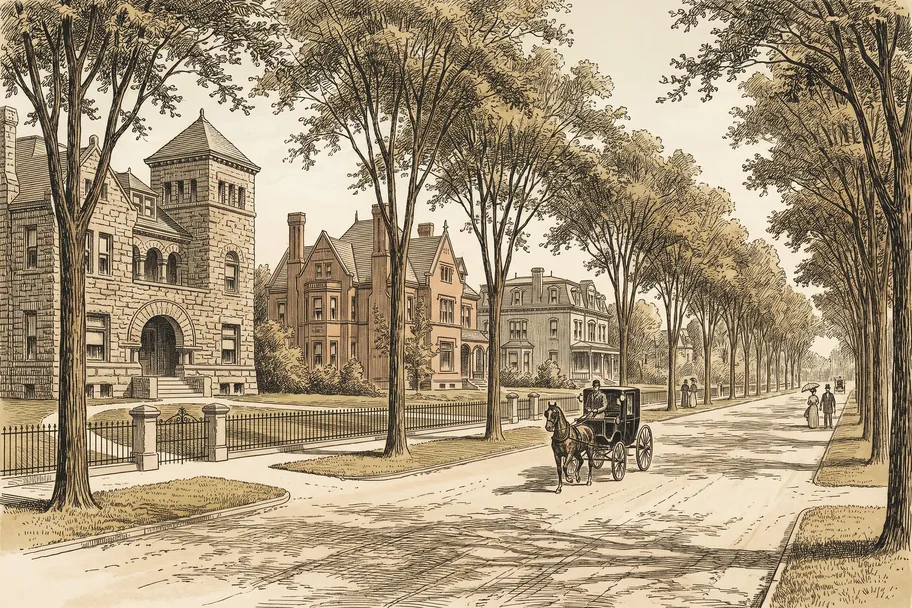
East Cleveland is a small city in Cuyahoga County, on Cleveland’s eastern border, that was incorporated as a village in 1895 and as a city in 1911. It grew up along Euclid Avenue as a prosperous streetcar suburb, home to John D. Rockefeller’s Forest Hill estate and General Electric’s Nela Park, then went through rapid racial change, fiscal crisis and population loss after 1960, while residents kept building the institutions and civic life that a story of decline usually leaves out.
This short history of East Cleveland draws on the Encyclopedia of Cleveland History and other sources listed below. It is meant as a starting point for anyone researching the city, its families or its institutions.
At a glance
- East Cleveland Township was organized in 1845. The present East Cleveland became a village in 1895 and a city in 1911.
- Its 1916 charter gave women the vote in municipal elections, which the Encyclopedia of Cleveland History calls “then the only such franchise east of Chicago.”
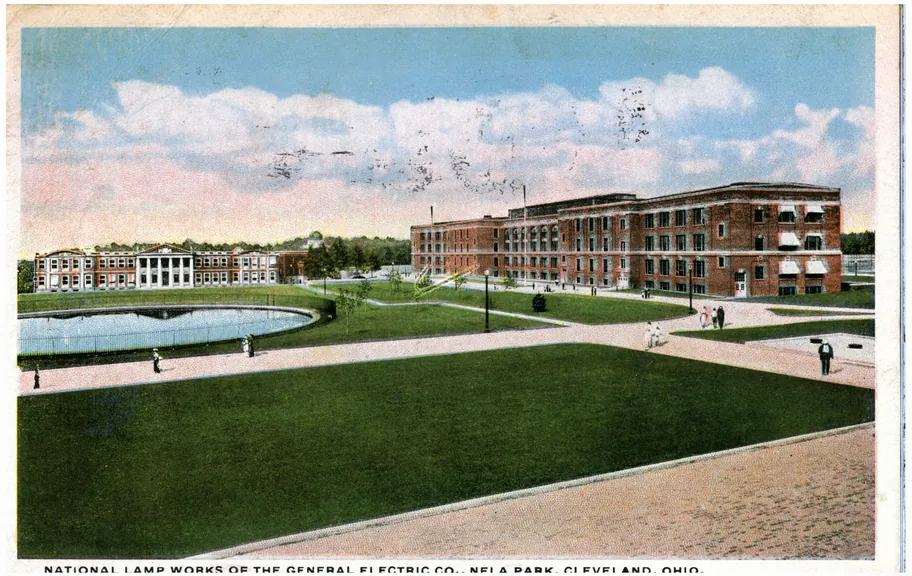
- Construction of Nela Park, the lighting research campus on Noble Road, began in 1911.
- The East Cleveland Public Library opened in 1916 with a gift from the Carnegie Corporation of New York.
- The city’s population peaked at 40,047 in 1950.
- In 2025 the East Cleveland Oral History Project recorded 25 interviews with residents, now archived in Cleveland Voices.
How did East Cleveland become a city?
The name East Cleveland is older than the city. East Cleveland Township was organized in 1845 from parts of Cleveland, Newburgh, Euclid and Warrensville townships. An earlier village called East Cleveland formed in 1866, but the City of Cleveland annexed it in 1872. The Encyclopedia of Cleveland History counts at least five political bodies in Cuyahoga County that have carried the name.
The East Cleveland that exists today was incorporated as a village in 1895 and as a city in 1911. Growth followed quickly: gas and water lines went in, Euclid Avenue was paved and streetcar service arrived from Cleveland. The population reached 10,000 in 1910 and passed 27,000 by 1920.
The city covers about three square miles, roughly seven miles from downtown Cleveland. It borders Cleveland’s University Circle and Glenville neighborhoods on the west and Collinwood on the north, with Cleveland Heights on the east and south. The steep Portage Escarpment runs parallel to Euclid Avenue, so part of the city sits on the Lake Erie plain and part on the bluff above it.
What made early East Cleveland distinctive?
East Cleveland chose independence more than once. Voters rejected annexation to Cleveland in 1910 and again in 1916. A charter was drafted in 1915, and the charter adopted in 1916 provided for women’s suffrage in municipal elections. In 1918 the city adopted a city manager plan.
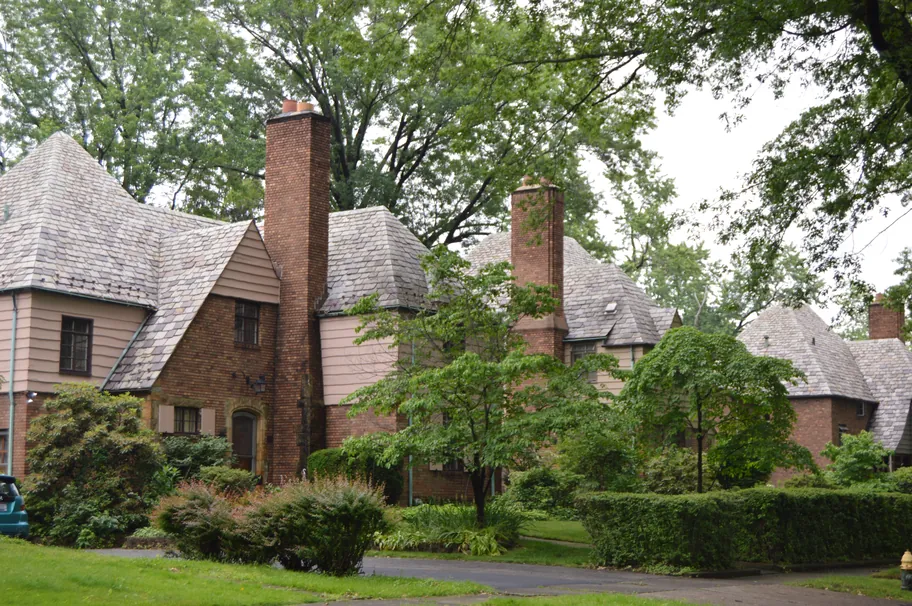
Most of East Cleveland’s houses were built in the 1910s and 1920s, and shopping districts formed where Euclid Avenue crossed Superior, Taylor and Lee roads. Charles A. Carran served as city manager from 1922 to 1962. The Encyclopedia of Cleveland History credits his strong housing inspection program with giving East Cleveland “a reputation as a stable, well-run city.”
What role did Forest Hill and Euclid Avenue play?
Euclid Avenue tied East Cleveland to Cleveland’s wealthiest corridor. In 1873 John D. Rockefeller bought a large tract along Euclid Avenue in East Cleveland. After a planned water-cure resort there failed, he ran the building as a club for one summer in 1878 and then kept Forest Hill as his family’s summer home, eventually about 700 acres reaching into Cleveland Heights. The house burned on December 17, 1917, and Rockefeller never returned to Cleveland. For the mansions closer to downtown, see our history of Millionaires’ Row on Euclid Avenue.
John D. Rockefeller Jr. later began a residential development on the estate. The two Encyclopedia of Cleveland History articles date its start differently, 1925 in one and 1929 to 1930 in the other, but both report that only 81 houses were built. In 1938 he donated Forest Hill Park to East Cleveland and Cleveland Heights. The Rockefellers also gave land for the East Cleveland Public Library, Huron Road Hospital and the junior high school.
Why did Nela Park and the library matter?
Beginning in 1911, the National Electric Lamp Association, later General Electric’s lamp division, built Nela Park on Noble Road. The Encyclopedia of Cleveland History describes it as “one of the earliest (if not the first) planned industrial research parks in the nation.” Our article on Nela Park covers its buildings, its holiday lights and its recent change of ownership.
The East Cleveland Public Library opened at 14101 Euclid Avenue on May 29, 1916. The Carnegie Corporation of New York gave $35,000, and the library reports that Rockefeller gave $3,600 to buy land for future expansion. Its story is told in our history of the East Cleveland Public Library.
How did East Cleveland change after World War II?
East Cleveland reached its peak population of 40,047 in 1950 and remained the most densely populated Cleveland suburb for the next decade. The Cleveland Transit System opened two rapid transit stations in the city in 1954. In the 1960s, ranch houses and high-rise apartments filled the remaining Forest Hill lots, and the population rose about 4 percent to 39,600 by 1970.
The racial makeup of the city changed quickly in the same years. Black families moving into neighboring Glenville in the 1950s began settling in East Cleveland’s western neighborhoods. In the 1960s, blockbusting real estate tactics stoked panic selling, and the city went from 2 percent Black in 1960 to 67 percent in 1970. By 1980, 86 percent of East Cleveland’s 36,957 residents were African American, which the Encyclopedia of Cleveland History ranks second nationally among major suburbs, after East St. Louis, Illinois.
What led to East Cleveland’s fiscal crisis?
The later twentieth century brought hard years. A citizen petition replaced the commission-manager government with a mayor and council in 1986, and in September 1988 the state formed a commission to manage the city’s finances. East Cleveland remained in fiscal emergency through the 1990s. The population fell to 33,096 in 1990 and 27,217 in 2000, down 30 percent from 1970, and the Encyclopedia of Cleveland History reports that it kept falling after that.
The same source names redlining, population flight and the subprime mortgage crisis among the causes. Along Euclid Avenue, small businesses, motels and fast-food outlets replaced many of the old houses. Talks in 2016 about annexing East Cleveland to Cleveland did not reach a result.
What has the East Cleveland community built and kept?
The decline narrative is only part of the record. In the 1990s, community efforts included the East Cleveland Coalition for a Better City and housing renovation by the city and the Lutheran Housing Corp. More recently, the Encyclopedia of Cleveland History notes a 6-acre solar farm operated by Evergreen Cooperatives and the Circle East townhouses on Euclid Avenue. The public library added a learning center and a performing arts center in 2005, and the performing arts center hosts free monthly concerts.
In 2025 the East Cleveland Oral History Project, directed by Dr. Nicholas S. Mays in partnership with the Cuyahoga Land Bank, recorded 25 interviews with residents past and present. The transcribed interviews are archived in the East Cleveland collection of Cleveland Voices, which describes their aim as widening the public story of the city “beyond crisis and decline to include strength, creativity, and enduring pride.” Themes include education, migration, faith, entrepreneurship, community development and neighborhood revitalization. Read more about the East Cleveland Oral History Project.
Why does East Cleveland’s history matter now?
East Cleveland’s history is a regional story told on three square miles: suburban ambition, industrial research, racial change, disinvestment and the work of rebuilding. Decisions about land, housing and annexation in the city are still being made, and they are better made with the full record in view, including the voices of the people who lived it.
Mays HisToracle Consulting helps community organizations, institutions and families research, record and share histories like East Cleveland’s.
Questions people ask
When was East Cleveland, Ohio, incorporated?
East Cleveland was incorporated as a village in 1895 and as a city in 1911, according to the Encyclopedia of Cleveland History. It grew out of East Cleveland Township, organized in 1845. An earlier village with the same name formed in 1866 but was annexed by the City of Cleveland in 1872, so the present city is the second municipality to carry the name.
Is East Cleveland part of the City of Cleveland?
No. East Cleveland is a separate city in Cuyahoga County, on Cleveland’s eastern border next to University Circle, Glenville and Collinwood, with Cleveland Heights to the east and south. Its voters rejected annexation to Cleveland in 1910 and 1916, and discussions about annexation in 2016 did not reach a result, according to the Encyclopedia of Cleveland History.
What is East Cleveland known for historically?
East Cleveland is known for John D. Rockefeller’s Forest Hill estate, for Nela Park, the lighting research campus begun there in 1911, and for its 1916 charter, which gave women the vote in municipal elections, then the only such franchise east of Chicago. It is also known for its Carnegie-funded public library, opened in 1916, and for the community life its residents have sustained.
Where can I hear East Cleveland residents tell their own history?
The East Cleveland Oral History Project recorded 25 interviews with residents in 2025. They are archived with transcripts in the East Cleveland collection of Cleveland Voices, a free online archive from the Cleveland State University Center for Public History + Digital Humanities. The interviews cover education, migration, faith, entrepreneurship, community development and neighborhood revitalization.
Sources
- East Cleveland, Encyclopedia of Cleveland History, Case Western Reserve University.
- Forest Hill, Encyclopedia of Cleveland History, Case Western Reserve University.
- Nela Park, Encyclopedia of Cleveland History, Case Western Reserve University.
- History of the library, East Cleveland Public Library.
- East Cleveland (25 transcribed interviews), Cleveland Voices, CSU Center for Public History + Digital Humanities.