Garrett Morgan: What the Cleveland Inventor Really Invented
Garrett Morgan was a Cleveland inventor who patented a smoke breathing device in 1914 and an improved three-position traffic signal in 1923.
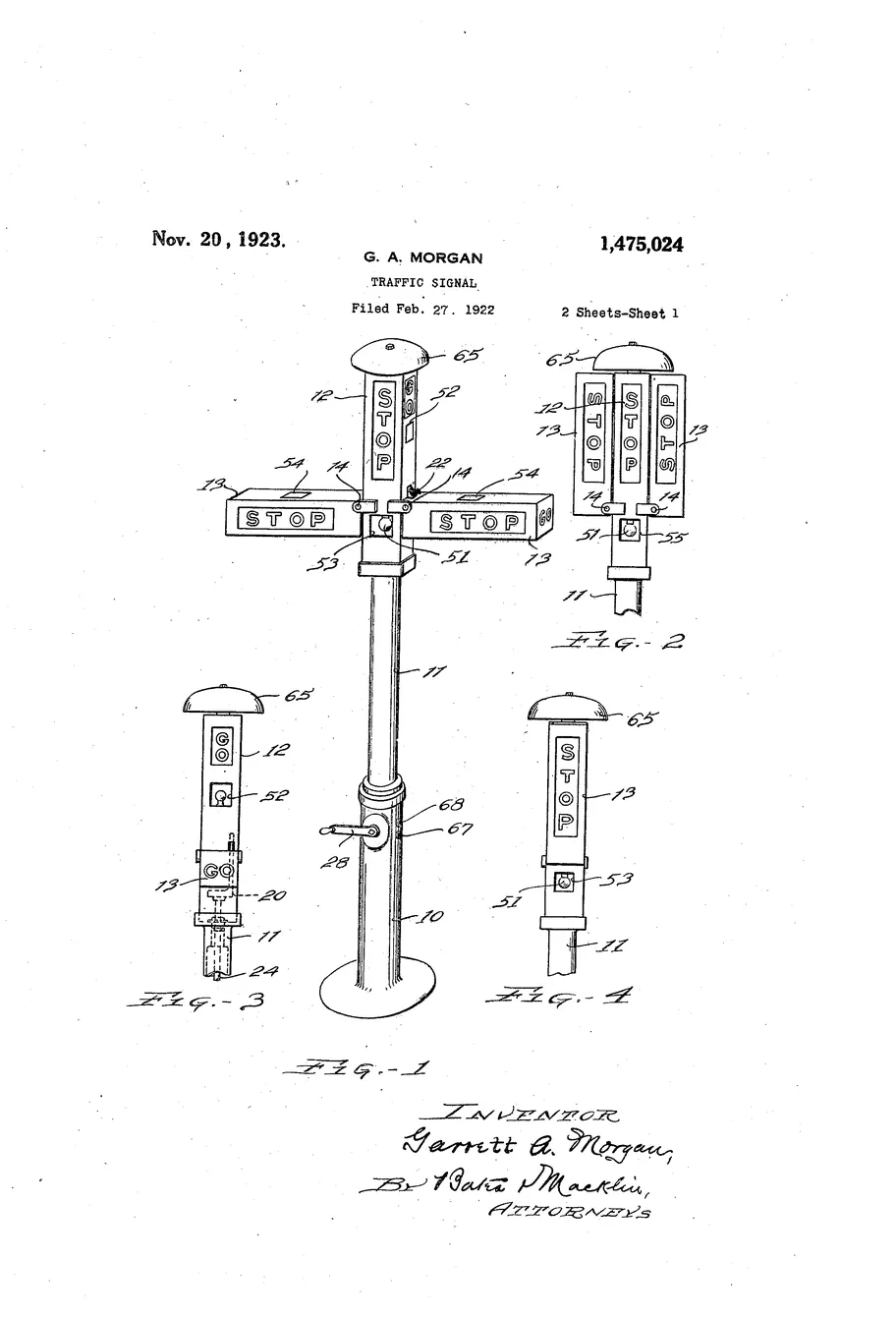
Garrett A. Morgan was a Black inventor and businessman in Cleveland who patented a smoke and gas “breathing device” in 1914 and an improved, hand-operated three-position traffic signal in 1923, U.S. Patent 1,475,024. He did not invent the first traffic signal: his patent improved on existing signals by adding a position that stopped traffic in every direction before any one direction was told to go.
That distinction matters, because Garrett Morgan is one of the most quoted names in Black history lessons and one of the most often misquoted. The record of his life in Cleveland is richer and more interesting than the myth, and it is well documented in patents, newspapers and archives.
At a glance
- Born March 4, 1877 (some records say 1879) in Paris, Kentucky; arrived in Cleveland on June 17, 1895.
- Breathing device: application filed August 19, 1912; U.S. Patent 1,113,675 issued October 13, 1914.
- Went into the Cleveland waterworks tunnel under Lake Erie with three other men after the explosion of July 24, 1916.
- Traffic signal: application filed February 27, 1922; U.S. Patent 1,475,024 issued November 20, 1923.
- Helped found the Cleveland Call newspaper around 1920.
- Died in Cleveland on July 27, 1963; buried at Lake View Cemetery.
Who was Garrett Morgan?
According to the Encyclopedia of Cleveland History, Morgan was born in Paris, Kentucky, to Sydney and Eliza Reed, both formerly enslaved. He had about six years of schooling and left home at 14 for Cincinnati. He came to Cleveland on June 17, 1895, and found work as a sewing-machine adjuster.
From there he built a series of businesses. He opened his own repair shop on West 6th Street in 1907, a tailoring shop with 32 employees in 1909, and the G. A. Morgan Hair Refining Company in 1913. He was also active in the city’s Black civic life, helping to found the Cleveland Association of Colored Men in 1908.
Morgan arrived years before the Great Migration reshaped Black Cleveland. The community he joined, and the much larger one that grew around him, is the subject of our companion piece on the Great Migration in Cleveland.
What was Garrett Morgan’s safety hood?
Morgan’s best-known early invention was a hood that let a wearer breathe in smoke or gas. He filed the patent application on August 19, 1912, and the U.S. Patent Office issued it as U.S. Patent 1,113,675, “Breathing device,” on October 13, 1914. The patent states its purpose: to “enable a fireman to enter a house filled with thick suffocating gases and smoke and to breathe freely for some time therein.”
The Encyclopedia of Cleveland History reports that Morgan introduced the device in 1912 and established the National Safety Device Company in 1914. The encyclopedia calls it an early gas mask, and popular accounts use the same phrase. The patent’s own term, a breathing device, is the most precise description.
What happened at the 1916 Lake Erie tunnel disaster?
Cleveland drew its drinking water through intake tunnels dug under Lake Erie, and the work was deadly. The Encyclopedia of Cleveland History counts six waterworks tunnel disasters between 1898 and 1916 that killed a total of 58 men. In the last, on July 24, 1916, workmen digging a tunnel hit a pocket of natural gas, a spark set off an explosion, and would-be rescuers who went in after them were overcome by gas.
At the request of the Cleveland police, Morgan, his brother Frank and two other men entered the gas-filled tunnel wearing his breathing devices. Historian Jim Dubelko, writing for Cleveland Historical, dates Morgan’s rescue to July 25, the morning after the explosion. The encyclopedia credits the party with rescuing two men and recovering four bodies before officials of the U.S. Bureau of Mines stopped further rescue efforts.
Sources differ slightly on the toll. The encyclopedia counts 11 men and 10 would-be rescuers killed, while Dubelko counts 20 victims in all, including a worker who fell from a crib into the lake and drowned during the recovery. Dubelko also records that the Carnegie Hero Fund Commission awarded medals to four white tunnel workers on January 24, 1917, and that the City of Cleveland refused to support the medal nomination of Garrett Morgan.
Did Garrett Morgan invent the traffic light?
No, and the patent record shows why. Signals at intersections already existed. James B. Hoge, also of Cleveland, filed a patent application in 1913 for a “municipal traffic-control system” that used lamps of distinctive colors and signs reading “Stop” and “Move” at street corners, and it was issued on January 1, 1918.
Morgan filed his own application on February 27, 1922, and received U.S. Patent 1,475,024 on November 20, 1923. Writing as a resident of Cleveland, in Cuyahoga County, he described his design as “a certain new and useful improvement in a Traffic Signal.” It was a manually operated signal on a post. Turning a crank raised and revolved its arms, which displayed the words “Stop” and “Go,” and the patent notes that those words were used “as is customary for this class of work.”
What was new was the sequence. In the patent’s words, one object of the invention was “stopping traffic in all directions before the signal to proceed in any one direction is given,” so that vehicles already partway across the intersection had time to clear it. The Encyclopedia of Cleveland History judges that this third, cautionary signal between “stop” and “go” is what made the design important, and reports that Morgan sold it to General Electric for $40,000 in 1923.
When you see Morgan described as the inventor of the traffic light, the accurate correction is simple: he patented an improved three-position traffic signal. Some popular websites also misprint the patent number; the correct number, printed on the patent itself, is 1,475,024.
What was the Cleveland Call?
Morgan’s work reached beyond invention into the press. The Encyclopedia of Cleveland History reports that the Cleveland Call was founded around 1920 by a group that included Morgan. In 1927 the Call merged with another struggling weekly, the Post, to form the Call & Post, which grew steadily after William O. Walker arrived in 1932 and became for many years Cleveland’s major African American newspaper.
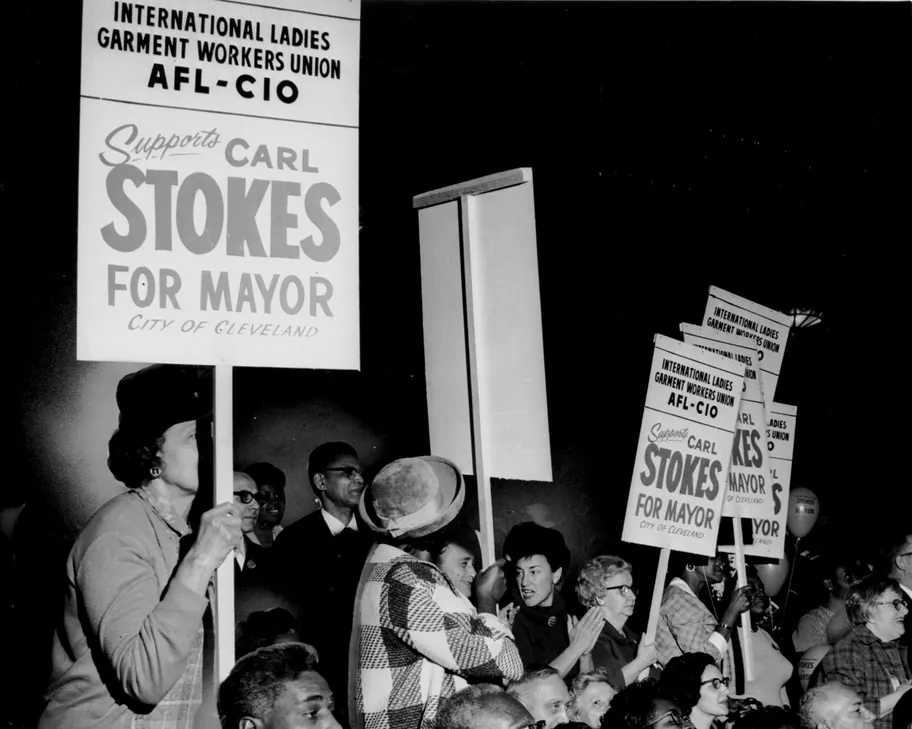
The Call & Post covered decades of Cleveland’s Black political life, including the era of Carl and Louis Stokes. Its pages are now a primary source in their own right for anyone researching Black Cleveland in the twentieth century.
How does Cleveland remember Garrett Morgan?
Cleveland marks Morgan’s legacy in public places. In 1991 the city’s Division Avenue Filtration Plant was rededicated and renamed in his honor, according to Cleveland Water, a fitting tribute given his role in the 1916 tunnel rescue.
In February 2024, at the Garrett Morgan High School Campus, Cuyahoga County Executive Chris Ronayne, joined by Morgan’s granddaughter Sandra Morgan and representatives of the Cleveland Metropolitan School District, declared March 4, Morgan’s birthday, as “Garrett Morgan Day” in Cuyahoga County, Signal Cleveland reported. The same report noted that his descendants had celebrated the rededication of a replica of his traffic signal on its 100th anniversary.
For researchers, the most important memorial is the paper trail. The Encyclopedia of Cleveland History lists finding aids for Morgan’s papers, scrapbook and photographs at the Western Reserve Historical Society, and his patents are freely searchable online. Our guide to Cleveland history archives explains how to begin with collections like these.
Why does Garrett Morgan’s story matter now?
Morgan’s real record is a better lesson than the myth. A Black entrepreneur with about six years of formal schooling built businesses, earned patents and risked his life in a rescue that the honors of his day passed over. Telling that story accurately, with the dates and the patent numbers, gives students and readers something they can check and trust.
The same is true of every local history. If your school, congregation or organization wants to present a Cleveland story with this kind of care, Mays HisToracle Consulting offers historical research, public presentations and curriculum development grounded in the primary record.
Questions people ask
Did Garrett Morgan invent the traffic light?
No. Traffic signals were already in use, and a Cleveland inventor, James B. Hoge, had patented an intersection signal system with colored lamps in 1918. Garrett Morgan patented an improved, hand-cranked signal in 1923, U.S. Patent 1,475,024. Its key feature was a position that stopped traffic in every direction before any direction was allowed to go.
What did Garrett Morgan invent?
His two best-documented inventions are a smoke and gas breathing device, often called a safety hood, patented in 1914 as U.S. Patent 1,113,675, and a three-position traffic signal patented in 1923 as U.S. Patent 1,475,024. He also built a hair-care products business in Cleveland, the G. A. Morgan Hair Refining Company, founded in 1913.
What did Garrett Morgan do in the 1916 Lake Erie tunnel disaster?
After an explosion in the Cleveland waterworks tunnel under Lake Erie on July 24, 1916, Morgan, his brother Frank and two other men went into the tunnel at the request of the Cleveland police, using his breathing devices. The Encyclopedia of Cleveland History credits them with rescuing two men and recovering four bodies.
Where is Garrett Morgan buried?
Garrett Morgan died in Cleveland on July 27, 1963, and is buried at Lake View Cemetery, according to the Encyclopedia of Cleveland History. Cleveland also honors him through the Garrett A. Morgan Water Treatment Plant, renamed for him in 1991, and the Garrett Morgan High School campus of the Cleveland Metropolitan School District.
Sources
- Morgan, Garrett A., Encyclopedia of Cleveland History, Case Western Reserve University.
- Waterworks Tunnel Disasters, Encyclopedia of Cleveland History, Case Western Reserve University.
- The 1916 Waterworks Tunnel Disaster: Twenty Clevelanders Die Four Miles Out in Lake Erie (Jim Dubelko), Cleveland Historical.
- US1475024A, Traffic signal (Garrett A. Morgan, issued November 20, 1923), Google Patents.
- US1113675A, Breathing device (Garrett A. Morgan, issued October 13, 1914), Google Patents.
- US1251666A, Municipal traffic-control system (James B. Hoge, issued January 1, 1918), Google Patents.
- Cleveland Call & Post, Encyclopedia of Cleveland History, Case Western Reserve University.
- History, Cleveland Water.
- Cleveland inventor Garrett Morgan with his own day (Helen Maynard, February 28, 2024), Signal Cleveland.